Data Centers: Destroying Us One Drop at a Time
Hello, friends and fellow seekers, walking toward a different way of living.
We recently took a trip to visit long-lost family members in Virginia. It’s rare to find people who align with our values—our quest to build a sustainable world grounded in peace, integrity, connection with nature, and personal responsibility. What they’ve accomplished on their modest property is nothing short of remarkable: a thriving food forest.
At first glance, it might look like a haphazard array of trees and bushes, but up close, it reveals an astonishing diversity of fruit trees, herbs, and greens, all grown through sheer love of nature and tenacity.
While there, we also visited a local gem, Forest Green Farm. It was a beautiful space with a wonderful farm shop, gardens, and greenhouses. You can read more on their website: forrestgreenfarm.com. I had the chance to speak with one of the owners, Krista. She told me that over 30 years ago, they bought a run-down farmhouse with weeds creeping right up to the steps. What they’ve created over the decades is magical—a place we can only aspire to emulate.
Distressingly, Krista also told me about a nearby data center. The consequences have been devastating: farms to the north have seen their well water levels drop or disappear entirely. This has destroyed not only the viability of those farms but also the livelihoods of the farmers. She repeated this story to anyone who would listen; the situation is so dire that she and her family are considering abandoning their decades-long creation to escape these behemoths. These data centers don’t just suck the environment dry—they also consume power at an alarming rate, causing local electric bills to skyrocket and necessitating the construction of invasive new power lines.
We saw numerous local signs posted on front lawns, urging an end to this endless construction. Unfortunately, I fear these signs will do little to dissuade powerful interests from continuing their rampage across the United States.
The Hard Reality Behind the Headlines
It turns out that Krista’s story is not an isolated incident. It is the tip of the iceberg for a region facing an unprecedented crisis. Virginia, particularly Northern Virginia (often called “Data Center Alley”), is the global epicenter of this industry. Unfortunately, the growth is happening with very little oversight.
According to the Lincoln Institute of Land Policy, there is currently no system of planning for land use, energy consumption, water consumption, or larger impacts on agricultural land, forests, and biodiversity associated with this boom. One official described the situation as “terrifying” because local land-use decisions are being made without any information about the broader aggregate impacts.[1]
To give you a sense of scale: Virginia has over 800 data centers, with nearly 360 million square feet of building space either approved or in the pipeline. To put that in perspective: 360 million square feet is equivalent to 6,250 football fields—an area just slightly larger than Palo Alto, California.
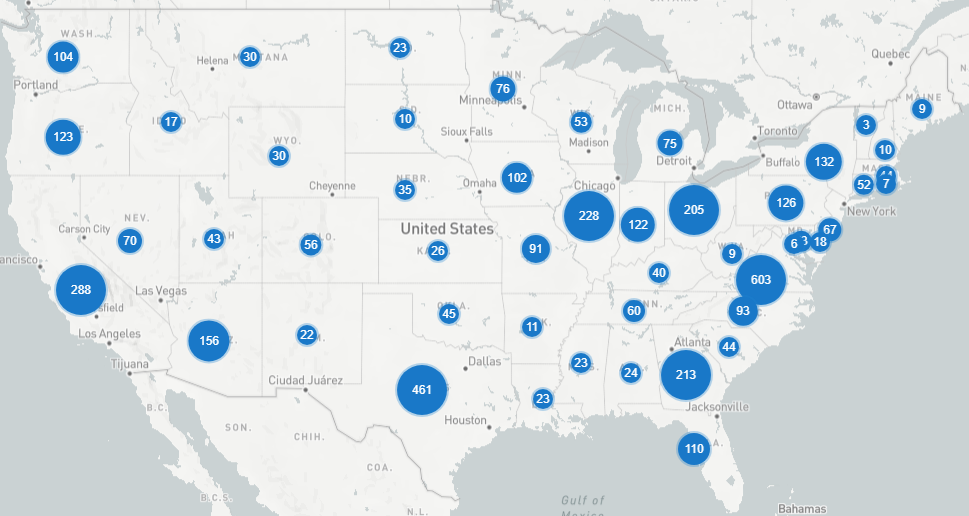
The truly horrific spread of data centers across the United States can easily be seen here: https://www.datacentermap.com/usa
The Thirst for Water
You might wonder why computer servers use so much water. The answer is cooling. These massive facilities generate immense heat and require millions of gallons of water daily to prevent overheating.
A single hyperscale data center can use up to 5 million gallons of water per day—equivalent to the water usage of a town of 10,000 to 50,000 residents.[2] In fact, the Potomac River—the drinking water source for millions in the Washington, D.C., area—was recently named the most endangered river in the United States for 2026, largely due to the water demands of data centers.[3]
The situation is alarming for several reasons:
· Evaporation Loss: Unlike water used in homes that returns to the watershed after treatment, up to 80% of the water used for cooling evaporates and is lost from the local environment.
· Summer Peaks: During hot summer months, water usage for cooling can triple, straining local rivers and groundwater just when farmers need water most.
· Drinking Water at Risk: The Interstate Commission on the Potomac River Basin warns that by 2040, water consumption in the region is projected to exceed supply—effectively running the faucet dry for the nation’s capital.
The Strain on Power and Your Wallet
These facilities also require an astonishing amount of electricity. Dominion Energy, Virginia’s largest utility, has stated that the demand is so high that new natural gas plants are being built specifically to power data centers. However, a critical question remains: Who pays for it? While Dominion claims data centers “pay their fair share,” energy researchers and consumer advocates strongly disagree.
· The Gas Plant: A $1.47 billion natural gas plant was approved to meet data center demand.[4] The rider (charge) for that plant went into effect recently, increasing bills for all Dominion customers, including residents who don’t use AI or cloud computing.
· Transmission Costs: In West Virginia, a transmission line built specifically to send power to Virginia data centers has more than doubled in projected cost (from $441 million to $960 million).[5] If approved, West Virginia ratepayers—who receive zero direct benefit from the data centers—could be on the hook for over $572 million.
Fighting against the machine
We must stand with the farmers in Virginia, the residents of West Virginia, and our own local communities to demand transparency. This is not a distant problem—it is coming to your town next. Wherever there is cheap land, lax regulations, and access to water and power, data centers are following. And they are bringing with them a familiar pattern: tax breaks for billion-dollar corporations, skyrocketing utility bills for working families, and a slow-motion ecological disaster that unfolds one evaporated gallon at a time
Data center proponents will promise jobs and tax revenue. Ask them: How many permanent jobs? (Typically, very few.) How much of that tax revenue goes to schools and roads, versus being returned to the company through subsidies? And most importantly, what happens to our wells, our rivers, and our children’s future when the water is gone?
We must ask our legislators: Why are our tax dollars subsidizing data center tax breaks while our water bills rise and our fresh water sources dry up? Why are we building natural gas plants to power the cloud while telling working families to conserve? Why do billion-dollar tech companies pay less for water than the small farmer down the road? These are not rhetorical questions. They demand answers. And if our elected officials will not provide them, we must elect new ones who will.
To the tech giants reading this: You have the capital, the engineering talent, and the moral responsibility to do better. Cool your servers with recycled wastewater. Build onsite solar and storage. Publish transparent water and energy reports. Locate facilities in places with abundant renewable energy and non-potable water sources. The technology exists. What is missing is the will.
But the bigger question is this: who decided that AI and data centers are more important than farms and families? Why are tech billionaires the ones deciding what's best for the rest of us? And why are their profits and their quest for power more important than the well-being of the other 99.9%?
To the residents of Data Center Alley and beyond: You are not powerless. The signs on front lawns matter. The voices at town hall meetings matter. The phone calls to state representatives matter. These industries expand only where we allow them to. Withdraw your consent.
Change starts with awareness. But awareness without action is just entertainment. Keep walking the path. Better yet—bring your neighbors. Bring your questions. Bring your outrage, focused and fierce and unwilling to look away.
The cloud is not ethereal. It is made of concrete, copper, and millions of gallons of vanishing water. And it is landing on all of us.
Change starts with awareness. Keep walking the path.
— The Living Roots Homestead team
[1] “The Wild West of Data Centers: Energy and water use top concerns,” Lincoln Institute of Land Policy, December 18, 2025, https://www.lincolninst.edu/publications/articles/data-center-boom-virginia
[2] “EPA Wants Companies to Reuse Water to Cool Data Centers,” Metropolitan Water Reclamation District of Greater Chicago, April 16, 2026, https://www.mwrd.org/news/epa-wants-companies-reuse-water-cool-data-centers-wall-street-journal
[3] “Potomac River Named Most Endangered in U.S. for 2026, Citing Data Center Growth and Water Demands,” Potomac Local News, April 20, 2026, https://www.potomaclocal.com/2026/04/20/potomac-river-named-most-endangered-in-u-s-for-2026-citing-data-center-growth-and-water-demands
[4] “Virginia Regulators Approve First New Gas Plant Since Passage of Clean Economy Act,” Inside Climate News, December 5, 2025, https://insideclimatenews.org/news/05122025/virginia-regulators-new-dominion-energy-gas-plant
[5] “Estimated Cost Of Power Transmission Line Project Doubles,” WV Public Broadcasting, March 24, 2026, https://wvpublic.org/story/energy-environment/estimated-cost-of-power-transmission-line-project-doubles